
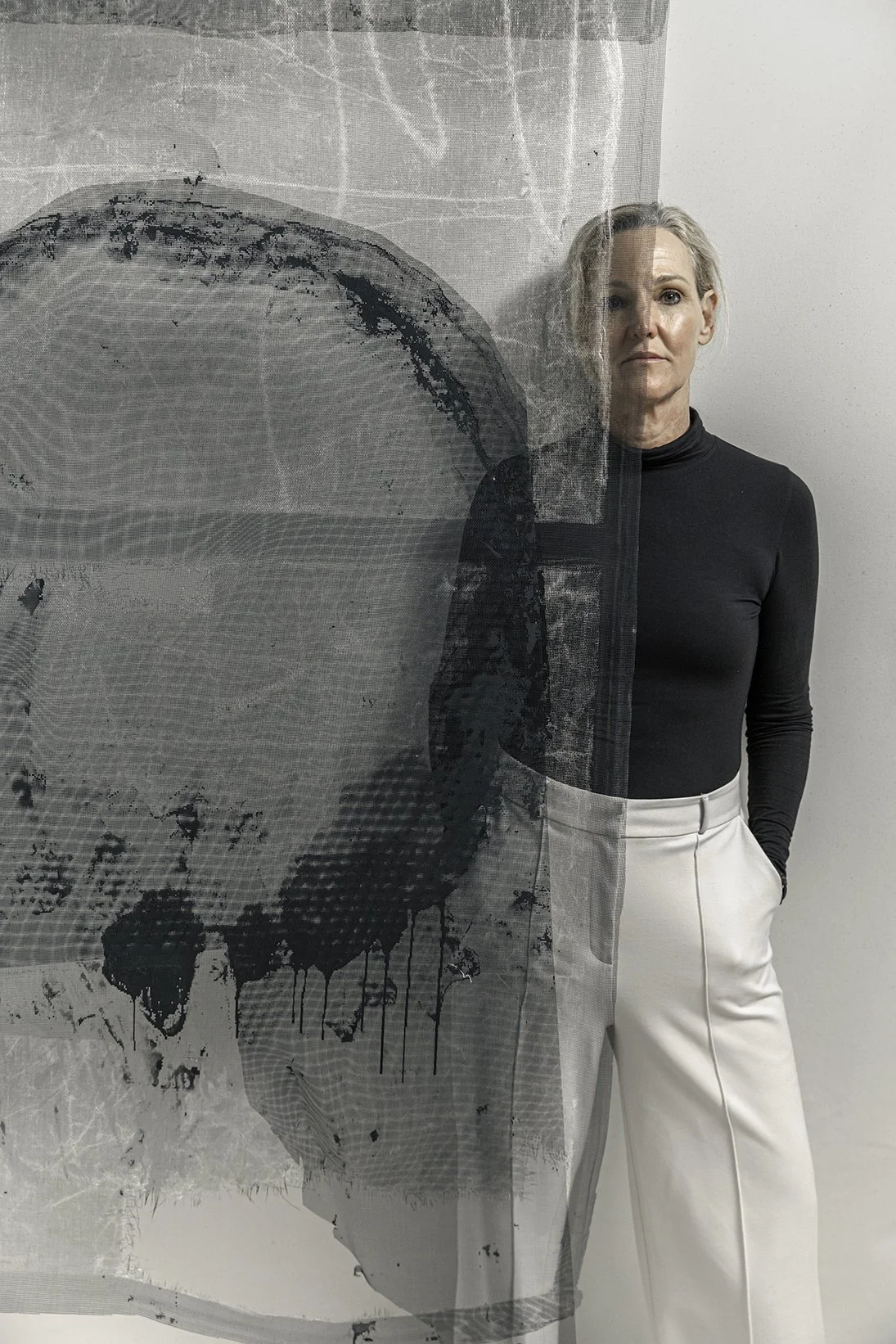
Caroline Christie-Coxon is an Australian interdisciplinary artist, born in South Africa and based in Western Australia. Developed over more than three decades, her practice explores relationship as a condition of existence — between body, material, place, consciousness and the living world.
Painting has been a generative foundation of Christie-Coxon’s practice. Her early investigations into fluidity, material behaviour, emergence and directed process established principles that have progressively expanded beyond the canvas into photography, video, sculpture, public art and site-responsive intervention. Across these forms, her work considers questions of belonging, interdependence, consequence and humanity’s participation within the systems it inhabits and transforms.
Born in South Africa and migrating to Australia in 1996, Christie-Coxon’s practice has been shaped by cultural transition and by living between countries with complex social, political and colonial histories. These experiences have informed an enduring sensitivity to belonging and separation, individual and collective identity, and the ways histories and systems of power shape relationships between people and place.
Early exposure to African art, alongside a longstanding enquiry into philosophy, consciousness, ecology and spiritual and contemplative traditions, contributed to her interest in recurring forms of human meaning-making across cultures and histories. The circle first emerged through her process-based painting as the Fluid Loop and subsequently developed into Circle Culture, a broader philosophical framework concerned with relationship, consequence and return.
In recent years, Christie-Coxon’s practice has become increasingly embodied and site-responsive. Working with minimal impact, she creates temporary encounters between body, Soft Paintings, sculptural forms, landscape, water and elemental forces. Here, the body operates as both material and perceptual instrument — vulnerable, responsive and implicated within the environments it encounters. Photography and video function not simply as documentation, but increasingly as artworks through which these transient relationships are witnessed and extended.
Christie-Coxon exhibits in Australia and internationally. Recent European presentations include Galleria Sonne, Silvaplana; Villa Arconati, Milan; THE I.C.E. Art in Motion, St. Moritz; and projects in Zurich. Her 2025 monograph, Circle Culture, published by SKIRA, surveys more than three decades of practice and its evolving philosophical framework.
In Australia, her work extends into significant public commissions, including large-scale works for the Western Australian Public Transport Authority and multiple civic collections. Across intimate, ephemeral encounters and permanent public works, Christie-Coxon continues to investigate how art might alter perception and deepen awareness of our relationship with one another and the living world.