SOFT THINKING
Soft Thinking emerged through Caroline Christie-Coxon’s material practice as a way of considering responsiveness, permeability and adaptation. It proposes softness not as weakness or passivity, but as a capacity to yield, receive, adjust and remain open to change.
Where rigid structures seek to hold their form, softness allows relationship to alter it. Material responds to gravity, water, wind, movement and touch; the body responds to place, scale and exposure. In this sense, softness becomes both a material condition and a way of thinking — one that allows uncertainty and transformation to remain active within the work.
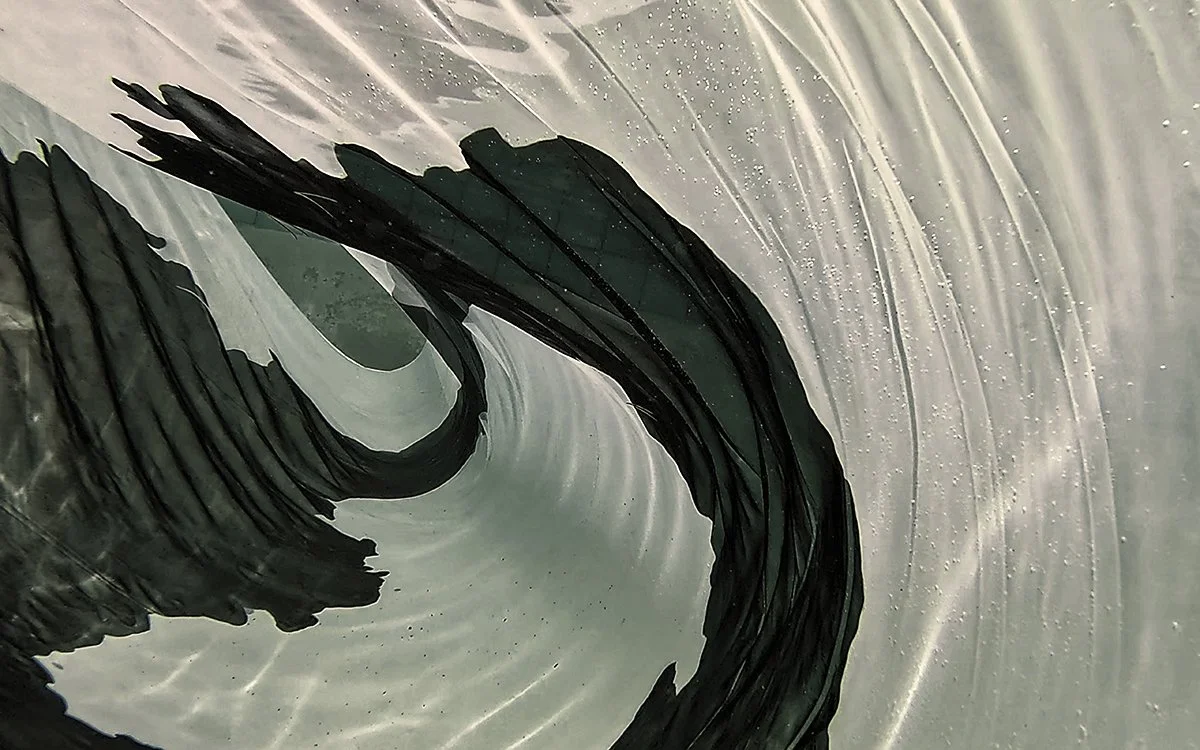
The Soft Paintings give physical form to this enquiry. Released from the fixed support of the traditional canvas, painted surfaces become porous, foldable and mobile. They can be carried, worn, immersed, suspended or temporarily placed within landscape, where environmental forces participate in how they are experienced and what they become.
This mobility has allowed painting to enter into new relationships with body and place. At times the Soft Paintings operate as veil or mantle; elsewhere they become sculptural forms or temporary interventions within land and water. Their meaning is not fixed by a single configuration but shifts according to the conditions they encounter. This has progressed further to include Soft Sculptures.
Soft Thinking extends this material experience into a broader proposition: that responsiveness can coexist with agency, vulnerability with strength, and yielding with intention. Rather than seeking mastery over material or environment, it considers what might emerge through attention, adaptation and participation.
Within the wider practice, Soft Thinking offers another way of understanding relationship — not as something static between fixed entities, but as an ongoing process through which each may affect and be affected by the other.